ABM with HubSpot for B2B SaaS: A Pilot-First Playbook
ABM pays off with complex products, high ACV and few winnable accounts. A pilot-first playbook with just enough structure to run it in HubSpot.
1) When ABM Makes Sense (and What “Good” Looks Like)
ABM wins over generic lead gen when your motion looks like this:
- Economics: high ACV, low deal volume (think ≤ ~20 wins/year around ~100k ACV).
- Complexity: multi-stakeholder buying, security/legal involvement, longer cycles.
- Strategy: progress on named accounts, not form-fill volume.
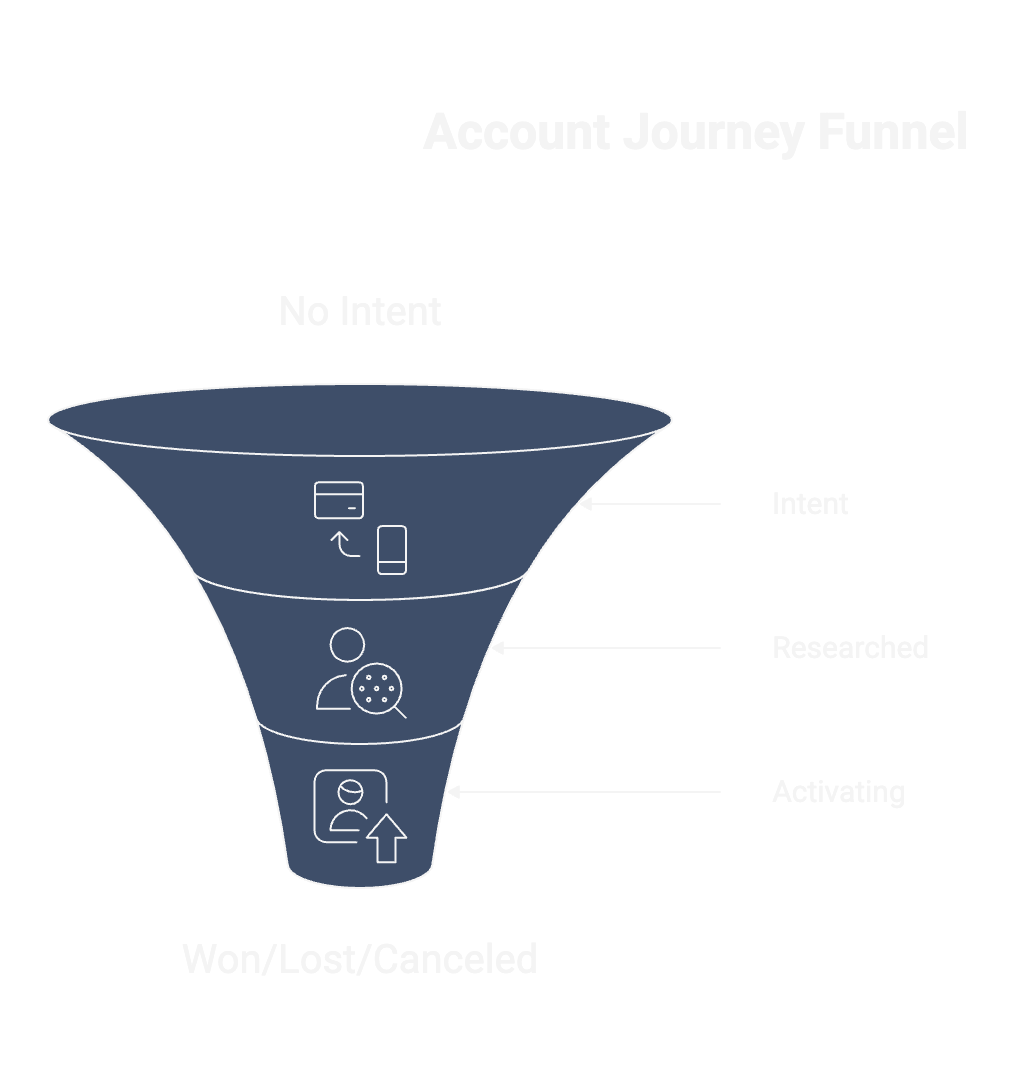
The outcome to aim for: A visible, shared account journey that runs alongside your normal deal stages:
- No Intent → 2) Intent → 3) Researched → 4) Activating → (Won/Lost/Canceled)
These “ABM brackets” are operational guardrails—lightweight, but enforceable—so everyone can see where an account truly stands.
2) The Minimal Data Model (Pro-compatible, Enterprise-ready)
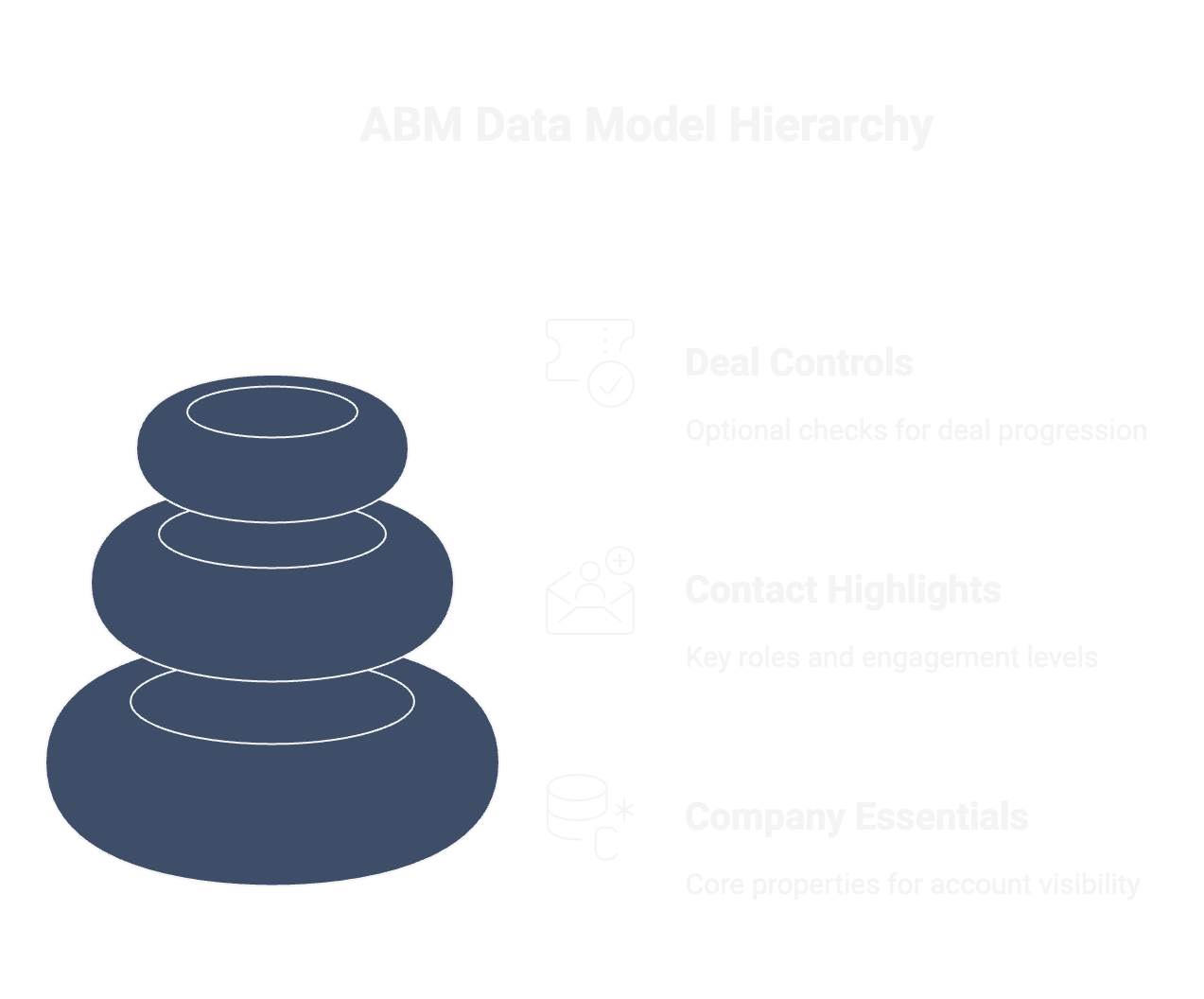
ABM fails without consistent fields. Create a small set of properties that make your work visible, reportable, and enforceable—mainly at company level.
Company (Account) essentials
abm_account_tier(Tier 1/2/3)abm_stage(No Intent / Intent / Researched / Activating / Closed–Won / Closed–Lost / Canceled)buying_center_roles(multi-select: Champion, Economic Buyer, User, Legal, Security, Procurement)key_pains(multi-select)sales_plays_allowed(Email, Phone, LinkedIn, Events, Direct Mail)activation_plan_url(link to doc or Deal Room)intent_sources(Website, G2, Events, Partners…)
Contact highlights
role_in_deal(Champion/Economic/User/Influencer/Blocker)threading_level(Single-threaded / Multi-threaded)
Optional deal controls
abm_gate_passed(Yes/No)required_info_complete(Yes/No)
Tip: Keep names boring and obvious. If a new AE can’t guess a field’s meaning, rename it.
3) Lists, Views & Boards That Drive Action
HubSpot is at its best when your working sets are obvious:
- Target Account Lists:
ABM Tier 1,ABM Tier 2,Pilot Accounts. - Research Queues: accounts missing buying center, no intent source, no pains captured.
- Activation Views:
abm_stage = Activating+ open tasks due in the next 7 days. - Kanban Boards: Company board by
abm_stagefor weekly stand-ups; Contact board filtered byrole_in_dealto expose single-thread risk.
4) Governance That Protects Data Quality (Without Killing Velocity)
If it’s not enforced, it won’t be filled. Tie conditional requirements to abm_stage changes:
- Move to Researched → require: ICP fit noted, buying-center roles selected, ≥1 intent source, key pains tagged.
- Move to Activating → require: Activation plan URL, ≥1 Champion and ≥1 Economic Buyer identified, allowed sales plays defined.
These gates prevent “phantom progress” and keep boards honest.
5) The Account Activation Plan (One Live Doc per Account)
ABM momentum comes from a shared, lightweight plan Sales and Marketing actually use—not a 20-page strategy deck.
One-pager structure
- Goals: e.g., 15-min with Economic Buyer; 3+ stakeholders in thread; schedule security review.
- Buying Center: Champion + Economic Buyer + key users/legal/security/procurement.
- Hypotheses & Value Cases: 2–3 short, testable statements tied to pains/outcomes.
- Plays (2–4 weeks):
- Sales: tailored 1:1 outreach (email/phone/LinkedIn).
- Marketing: LinkedIn account ads to target roles.
- Content: customer story + value one-pager.
- Event: invite to live demo or exec briefing.
- Milestones/KPIs: time-to-first-meeting ≤ 14 days; ≥3 stakeholders engaged; movement from Intent → Activating.
Keep this doc linked via activation_plan_url so anyone can find it in one click.
6) Channels & Tactics (Pilot Manually, Automate Later)
Start simple to learn fast, then scale what works.
What to do now
- Sync LinkedIn Matched Audiences from HubSpot lists (contacts or companies) with dynamic updates.
- Run manual outreach (email/phone/LinkedIn) to validate messaging; templatize and scale via sequences after proof.
- Use broad account ads sparingly for Tier-1 (short bursts to build internal buzz).
- Prioritize decision-accelerators: security/Legal readiness notes, “how to buy,” executive briefs, relevant references.
What to defer
- Complex multi-tool cadences and heavy automation until your plays are producing meetings and threading.
7) Reporting That Leaders Actually Use
Measure at the account level and roll up learnings weekly. Your first dashboard can be this simple:
- Accounts by ABM Stage (No Intent → Activating → Won/Lost)
- Engaged Accounts (7/30 days) across web, email replies, meetings, and ad interactions
- Meetings per Tier/Account and Threading (stakeholders per deal)
- Time-in-Stage & Bottlenecks (Intent → Activating)
- Coverage vs. Target by Tier (3–5× based on cycle & win rate)
On Professional: use Campaigns + Traffic Analytics; consolidate multiple “source” fields into 1–2 clean properties; add a Self-Reported Attribution field to key forms.
On Enterprise: add Buyer Journey, Custom/Behavioral Events, Account-rollups, and light scoring.
8) Lightweight Scoring (Only What You’ll Act On)
Start with signals that correlate with progress; recalibrate monthly.
- +10 Meeting with Champion
- +8 Meeting with Economic Buyer
- +5 ≥3 stakeholders active
- +3 High-intent website signal or credible 3rd-party intent
- −5 14 days without response while in Activating
Once stable, automate via workflows (Custom Events if on Enterprise).
9) Operating Rhythm: The Boring Stuff That Works
ABM is a team sport. Make collaboration unavoidable (in the good way).
Weekly ABM stand-up (30–45 min)
- Walk the company board by ABM stage.
- Remove blockers, assign owners and next plays.
- Log learnings; update the activation plan.
Clear RACI
- Sales: outreach & meetings.
- Marketing: ads & content.
- Ops: data, lists, workflows.
- CS: references/use cases.
Pilot criteria
- 10–20 Tier-1/Tier-2 accounts; target meetings/threading/time-to-first-meeting. Review at 6–8 weeks, then scale what’s proven.
10) Stack Options (Suite vs. Best-of-Breed, Without Religion)
Start minimal: HubSpot Sales + Marketing, LinkedIn Ads (audience sync), optional enrichment/visitor-ID, calendar/meetings.
Add later (if needed): sequencing tool, deeper visitor-ID, enrichment, event platform, reference hub.
All-in-one suites: convenient but pricey—HubSpot + targeted add-ons covers most enterprise ABM use cases with less complexity.
11) Anti-Patterns (and the Fix)
- Automating too early: validate plays manually first.
- No gating: enforce conditional required fields; otherwise reports will lie.
- Too many stages: keep ABM brackets lean; use notes, not stages, for nuance.
- Fuzzy ownership: set and publish RACI; hold the weekly.
- Lead-thinking: celebrate account advancement, not form fills.
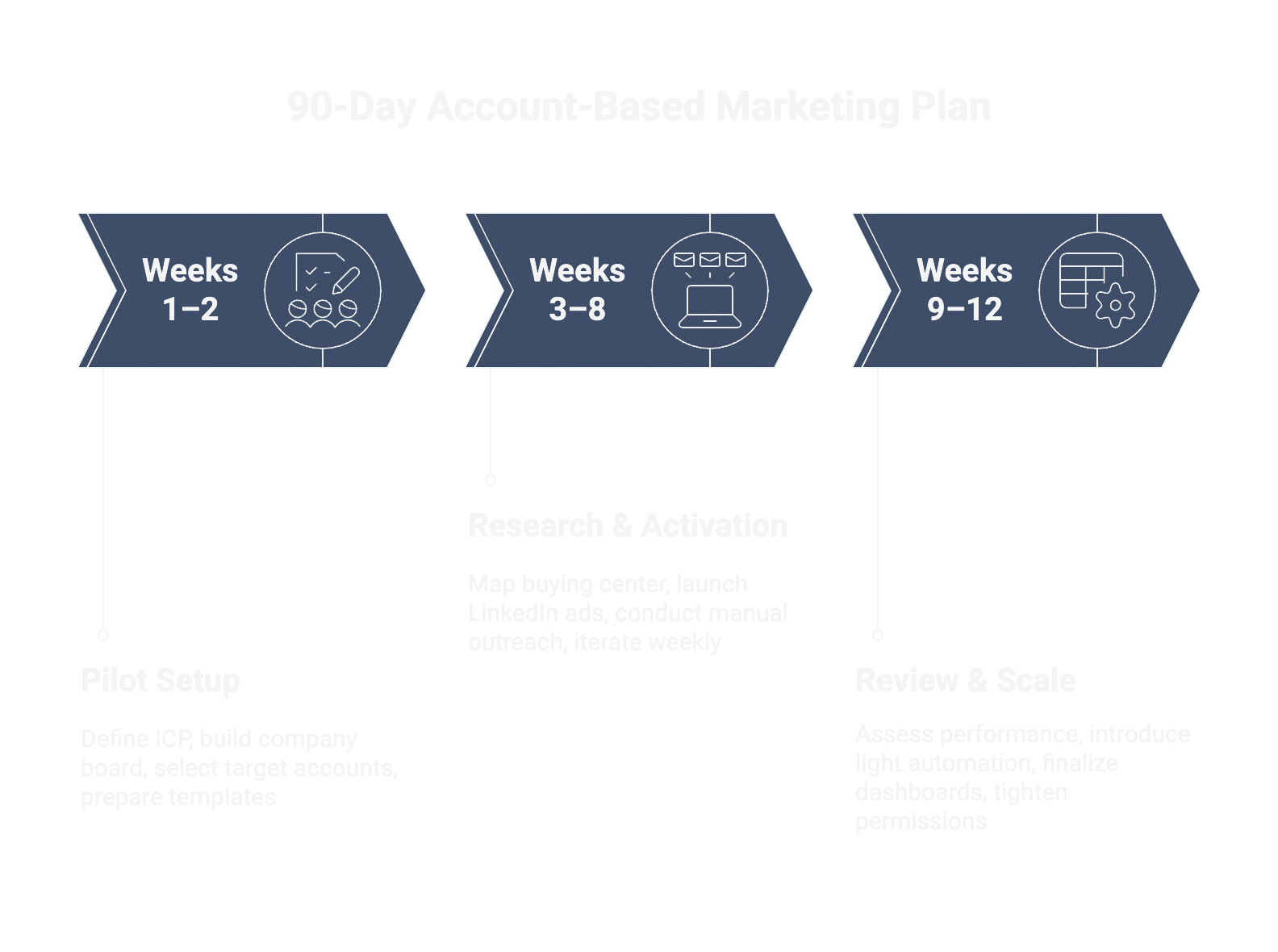
12) A 90-Day Plan You Can Commit To
Phase 1 – Pilot Setup (Weeks 1–2)
- Define ICP and tiering.
- Create properties/lists/views; build the company board by
abm_stage. - Pick 10–20 target accounts; open research tasks.
- Prepare templates: 3–5 emails, 1 champion doc, 1 case story.
Phase 2 – Research & Activation (Weeks 3–8)
- Map buying center; draft hypotheses/value cases.
- Launch LinkedIn account ads + manual outreach.
- Run the weekly stand-up; iterate per account.
Phase 3 – Review & Scale (Weeks 9–12)
- Assess: meetings, threading, time-in-stage, coverage.
- Introduce light automation (audience sync, simple workflows).
- Finalize dashboards; tighten gates/permissions.
Quick Checklists (Copy/Paste)
Before activating an account
- Tier assigned
- Champion + Economic Buyer identified
- Hypotheses/value case noted
- Activation plan linked
- KPIs defined (e.g., first meeting ≤ 14 days)
Weekly ABM stand-up
- Review by ABM stage
- Clear blockers
- Assign next plays & owners
- Log learnings & update plan
Frequently asked questions
1) Should ABM be account- or deal-driven?
2) How do we avoid single-thread risk?
3) What’s the smallest viable pilot?
4) When should we add external tools?
5) How do we report ABM on HubSpot Professional?
A free 60-minute Launchpad clarifies which lever should move first. No pitch, honest fit / no-fit answer and a clear next step.